Private Mortgage Lenders vs Banks in Canada: What’s the Difference?
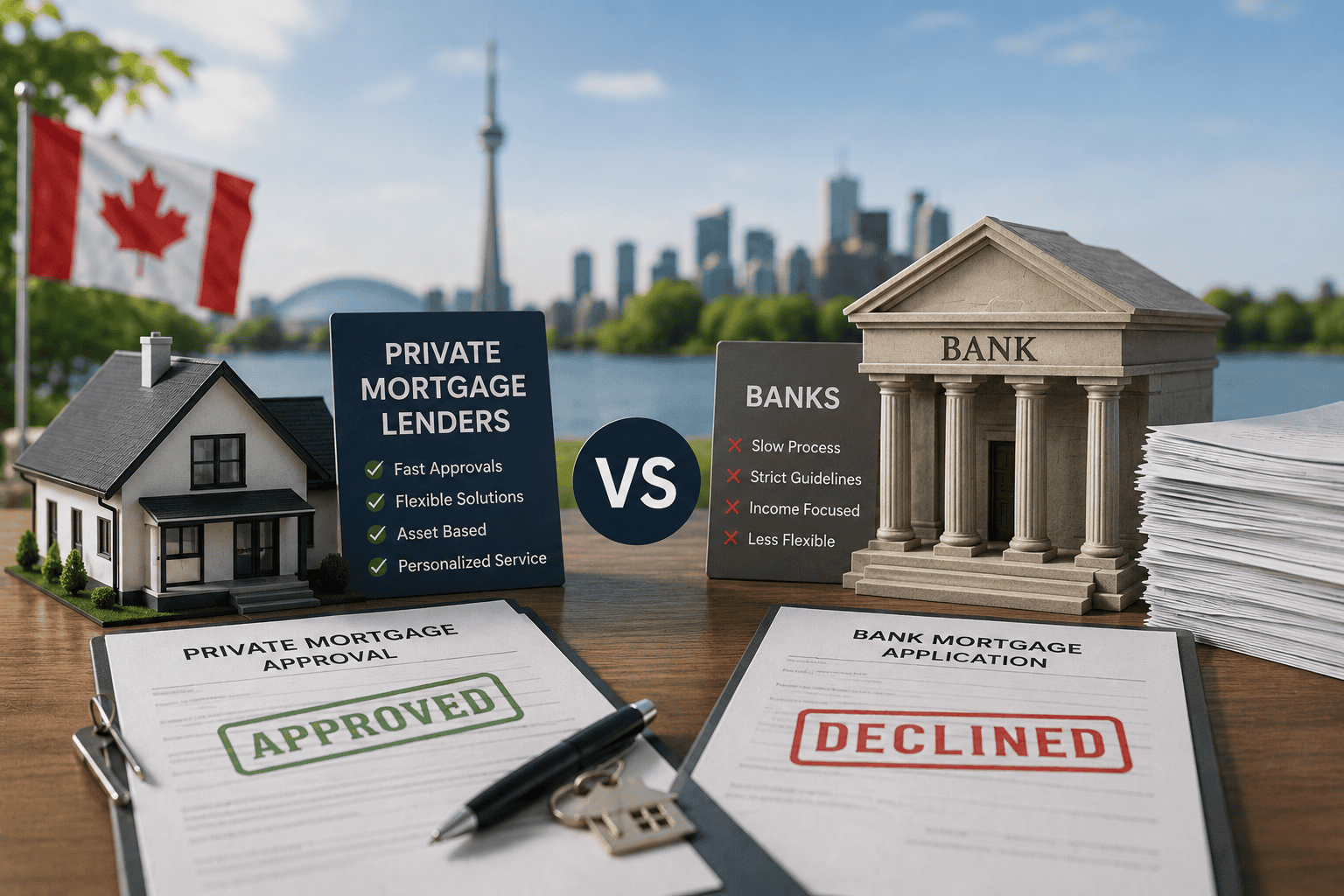
When it comes to financing a home in Canada, understanding private mortgage lenders vs banks is one of the most important decisions you will make. Private mortgage lenders vs banks offer very different approval criteria, timelines, and loan structures, and the right choice depends entirely on your financial situation, credit history, and how quickly you need to move.
According to FSRA’s Annual Report, there are now 65,233 private mortgages worth $32 billion active in Ontario alone, representing 15.8% of the mortgage market. The CMHC 2026 Mortgage Consumer Survey found that 39% of Canadian mortgage holders are still concerned about making their payments, highlighting the growing importance of understanding all available financing options.
This guide breaks down the key differences between private mortgage lenders vs banks in Canada, including a side by side comparison, real examples, and answers to the most common questions so you can make an informed decision.
What Are Private Mortgage Lenders vs Banks in Canada?
Private mortgage lenders are individuals or corporations who provide short-term mortgage financing outside the traditional banking system. They are a common alternative to bank mortgages and help many borrowers who do not qualify for conventional financing get approved quickly.
When comparing private mortgage lenders vs banks, the key difference is that private lenders focus primarily on the value and equity in your property rather than your credit score or income documentation. This makes the approval process faster and more accessible for a wider range of borrowers.
Learn more about private mortgage lenders in Ontario and how they can help you get approved.
Private Mortgage Lenders vs Banks: Side by Side Comparison
| Feature | Private Mortgage Lenders | B Lenders | Banks (A Lenders) |
|---|---|---|---|
| Approval Based On | Home equity | Credit and income | Credit, income, stress test |
| Minimum Credit Score | None | 550 to 600 | 680 or higher |
| Income Verification | Not required | Required | Required |
| Stress Test | No | Sometimes | Yes |
| Approval Speed | 24 to 48 hours | 3 to 7 days | 2 to 4 weeks |
| Loan Term | 1 to 3 years | 1 to 5 years | 1 to 5 years |
| Interest Rates | Higher | Moderate | Lowest |
| Flexibility | High | Moderate | Low |
| Best For | Urgent situations, bad credit, no income | Bruised credit, self-employed | Strong credit, stable income |
Private Mortgage Lenders vs Banks: Pros and Cons
Private Mortgage Lender Pros
- Faster approvals — often within 24 to 48 hours
- Less documentation required
- No stress test requirement
- Approval based on property equity, not credit score
- Flexible loan structures including interest-only payments
- More mortgage options tailored to your specific situation
- Personal service and expert guidance throughout the process
Private Mortgage Lender Cons
- Higher interest rates than banks
- Short-term solutions requiring an exit strategy
- Additional fees including lender fees, broker fees, and legal costs
Traditional Bank Mortgage Pros
- Lower interest rates for qualified borrowers
- Longer loan terms up to 25 years
- Existing customers may receive discounts or special programs
- More regulatory oversight and borrower protections
Traditional Bank Mortgage Cons
- Strict federal regulations limit flexibility
- Require credit checks and extensive documentation
- Harder to verify non-traditional or self-employed income
- Longer approval and funding timelines
- Must pass the mortgage stress test
- Limited loan options compared to private lenders
Who Should Choose Private Mortgage Lenders vs Banks?
Understanding private mortgage lenders vs banks comes down to your personal situation. Private lenders are particularly well suited for:
- Self-employed borrowers with non-traditional income
- Homeowners with bad credit or recent missed payments
- Borrowers who have been turned down by a bank
- Those who need fast access to funds for urgent situations
- Homeowners facing a power of sale or foreclosure
- Those needing to pay property tax arrears
- Borrowers who need to consolidate high-interest debt
Banks remain the better option for borrowers with strong credit, stable verifiable income, and no urgency around timing.
Real Example: When Private Mortgage Lenders vs Banks Made the Difference
Case Study: Self-Employed Homeowner in Toronto
A Toronto homeowner with a $850,000 property and $380,000 remaining mortgage balance had been self-employed for three years. Despite having strong equity in her home and a growing business, her bank declined her refinancing application because she could not provide two consecutive years of T4 income documentation.
She needed $75,000 to consolidate high-interest business debt that was affecting her cash flow. Her credit score was 598 due to a few late payments during the early stages of her business.
Turnedaway.ca arranged a private second mortgage based on her available equity. The funds were used to consolidate her business debt, reduce her monthly obligations by over $900, and stabilize her cash flow. Eighteen months later she refinanced with a B lender at a lower rate after her credit score improved and her business income was more established.
How to Transition From Private Mortgage Lenders Back to Traditional Financing
A private mortgage should always be a short-term solution with a clear exit strategy. Here is how most borrowers transition back to traditional financing after choosing private mortgage lenders vs banks:
- Improve your credit score — make all payments on time during the private mortgage term
- Document your income — build a track record of verifiable income over 12 to 24 months
- Reduce your debts — use the private mortgage to consolidate and eliminate high-interest obligations
- Work with a broker — a licensed mortgage broker will help you plan your path back to A or B lender financing
Most borrowers who use private mortgages strategically are able to transition to a B lender or bank within one to two years.
Frequently Asked Questions: Private Mortgage Lenders vs Banks Canada
Can I switch from a private mortgage to a bank mortgage?
Yes. Most borrowers use a private mortgage as a short-term bridge while they improve their credit, stabilize their income, or resolve financial issues. Once your situation improves, a licensed broker can help you refinance into a bank or B lender mortgage at a lower rate.
Are private mortgage lenders regulated in Canada?
Yes. In Ontario, private mortgage lenders and brokers are regulated by the Financial Services Regulatory Authority of Ontario (FSRA). Always ensure your broker is licensed before proceeding.
How much more expensive is a private mortgage vs a bank mortgage?
Private mortgages carry higher interest rates than bank mortgages to reflect the added risk and flexibility. The full cost of borrowing also includes lender fees, broker fees, legal costs, and appraisal fees. A licensed broker will provide a full cost breakdown before you commit.
Can I get a private mortgage with no income?
Yes. Private lenders do not require income verification. Approval is based on the equity and value of your property. This makes private mortgages accessible for retired homeowners, those between jobs, or anyone whose income is difficult to verify through traditional means.
What happens when my private mortgage term ends?
When your private mortgage term ends you have several options: renew with the same lender, refinance with a new private lender, transition to a B lender or bank if your situation has improved, or sell the property. Planning your exit strategy before you enter into a private mortgage is essential.
What is the minimum equity required when choosing private mortgage lenders vs banks?
Private mortgage lenders in Ontario typically require a minimum of 15% to 20% equity remaining in your property after the loan. Banks require you to pass the stress test and maintain strict debt service ratios regardless of your equity position.
Making the Right Choice: Private Mortgage Lenders vs Banks
The private mortgage lenders vs banks decision comes down to one question: do you qualify for a bank mortgage, and does it meet your timeline and needs? For many Canadians, understanding private mortgage lenders vs banks is the first step toward finding the right financing solution.
If a bank has said no, a private mortgage lender in Canada may be the right bridge to get you back on track. Private mortgage lenders vs banks offer a fundamentally different approach — one built around your property value and your situation rather than rigid qualification criteria.
At Turnedaway.ca, we have over 30 years of experience helping homeowners navigate the private mortgage lenders vs banks decision. Learn more about private mortgage lenders in Ontario, explore our debt consolidation solutions, or call us at 1-855-668-3074 to get started. Approvals in as little as 24 hours.